
Explore the Conference
The Diaspora Child Strikes Back – Virtual Conference – June 11-13, 2026
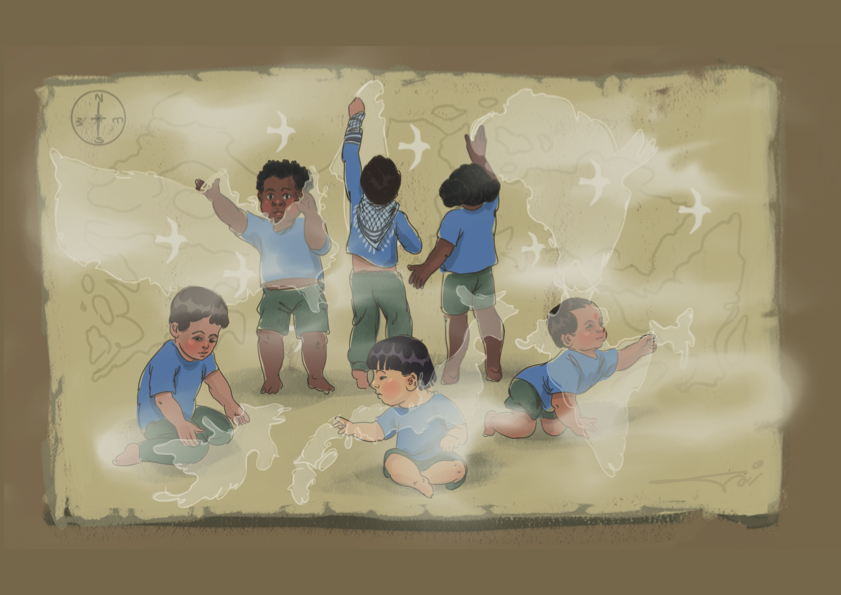
The Diaspora Child Strikes Back is a multidisciplinary conference on Transnational Desires and Childhoods of Empire as a means of continuing a critical, multidisciplinary dialogue around Black childhoods and childhoods of color. We seek to convene scholars, writers, practitioners, artists, and advocates for children interested in wrestling with the tensions around diasporas and immigrations globally especially as we have seen a rise in nationalism(s) within the US and abroad. In Decolonizing Diasporas, Yomaira Figueroa writes about the importance of decolonial thinking and writing when revisiting the histories of imperialisms that have essentialized ideas around nation, language, race, and ethnicity.
Acknowledging the challenges that many of our international and student communities have expressed in traveling to the US, we have decided to pivot and hold this year’s Mellon conference online. Stay tuned for more announcements about exciting opportunities we will offer in this virtual space.

Confirmed Speaker! Angie Cruz!

Confirmed Speaker! Dr. Django Paris

Confirmed Speaker! Dr. Valentina Migliarini
The history of the United States is one of competing settler colonial projects, including waves of European immigration and participation in the Trans-Atlantic slave trade, across Indigenous lands today known as 50 incorporated states. Today, we see how the battle for teaching US history still veils the existence of certain settler narratives, cultures, and even childhoods. At the same time, we see how the US continued non-continental expansions and interventions in Mexico, Latin America, the Caribbean and the Middle East, though the children of these conquests and expansions, upon entering US borders, are often seen as unwanted strangers.
Our ideas about diaspora(s) should also take into account how diasporas move continually and in ever expanding directions. Diasporas also vary in terms of who fled and why”for example, historical accounts tend to favor affluent communities displaced by political upheaval rather than working-class communities. We take our inspiration from scholars in Childhood Studies such as Marilisa Jimenez Garcia and Sonia Alejandra Rodriguez, Lara Saguisag who have called for more examination around US empire and children’s and youth studies. We also take inspiration from AfroLatine scholars who have revolutionized ideas about race, ethnicity, and nationality. In Juan Flores’ The Diaspora Strikes Back (2007), Flores writes about the ways moving diasporas impact homeland and settlement cultures in both directions, calling them “remittances.” Flores calls attention to how these remittances create “major social changes because of this intense intersection of transnational desires.”
Flores writes:
” In many parts of the world, return migrants and their children are bringing significant changes and challenges to home countries, and thereby altering the direction and impact of cultural and political flows that result from international migration and diasporic settlement. Whether it is Turkish or Spanish “guest workers” returning from long-term stays in Germany, Japanese Brazilians moving “back” to Japan, Mexican immigrants in the United States taking active part in the civic life of their hometowns, or Dominicans shuttling between San Juan or New York and the Dominican Republic, returning emigrant nationals (“remigrants”) of many countries bring cultural ideas and values acquired in diaspora settings to bear on their native lands or that of their forebears, often with boldly innovative and unsettling effect (3). “
Conference themes might include (but are not limited to):
- The impact of diaspora on racial ideologies for children and childhoods worldwide.
- US childhoods of color and diasporas in children’s and young adult literature and media.
- Transnational Blackness and representations of children and children.
- Considerations of the US economic and political interventions broadly and their impact on children’s lives, cultures, and literatures.
- Colonial and Black childhoods in St. Augustine, New Orleans and the Southwest territories before US annexations.
- Consideration of disabled diaspora children’s childhoods and the politics of disability, debility and capacitation
- Childhood and youth cultures in the US occupied lands such as the Philippines, Puerto Rico, Hawaii, Alaska, and the US Virgin Islands.
- Latin American and Caribbean diasporas into the US and Caribbean presence in the
- US imaginary, and including pop culture, art, film, literature, and sports.
- Diaspora children of the various US interventions in the Middle East, including Afghanistan, Kuwait, and Iran.
- Diasporas impacting identity on childhoods in the US South
- Local childhoods of color impacted by the US Empire, including local New Jersey and Philadelphia immigrant diasporas and indigenous communities.
- Children of Climate Diasporas and global disasters.
- Unsettling borders around language histories or how diasporas have shaped linguistic practices in the US and abroad.
- Transnational authors and artists for children working in multiple locations.
- Youth traveling and working in multiple sites of Empire.
This conference is funded by a grant on Rethinking Race and Justice Through Childhood Studies from the Andrew W. Mellon Foundation.
The Department of Childhood Studies at Rutgers University-Camden is the nation’s first doctoral degree-granting program in Childhood Studies. Its faculty members come from a wide spectrum of scholarly disciplines. The Rutgers-Camden Campus is in Camden, NJ, just across the Delaware River from Philadelphia, PA, and about two hours south of New York City.
Questions
Please direct any questions about the conference and/or the submission process to the conference co-conveners Marilisa Jimenez Garcia, Naomi Fair, and Meredith Bak at: csmellonconference@gmail.com